Standard deviations in population traits

Standard deviations are a somewhat neglected topic when it comes to the statistical analysis of group differences. And when it comes up, it usually only for the explanation of some tail effects: A larger standard deviation leads to more outliers and beats a higher mean if you go far out onto the tail of the distribution. Brilliant example: La Griyffe du Lion’s analysis of crime rates and serial killers [1].

But standard deviation are interesting beyond these tail effects. For example environmental hardship or strong environmental influences on a trait should generally increase the standard deviation. If half of all kids in a village get a disease that costs a few IQ points this will increase standard deviation in IQ, compared to a country where this disease has been eradicated. You can often see this effect in scholastic achievement studies where the standard deviation of second generation immigrants can be notably lower than that of first generation immigrants. In second generation immigrants language ability, health and malnutrition varies a lot less than among first generation immigrants and so does every trait downstream of these.

This makes it striking that the standard deviation of IQ in African Americans and of Africans generally, is usually lower than the SD of white Americans or European populations, despite the undoubtably worse environmental conditions. African American standard deviation in IQ for example varies between 11 and 14 points compared to a white SD of 15. Given that a worse environment should increase the SD, this lower SD most likely is due to genetic reasons. In this post I want to discuss possible influences on these differences in standard deviations.
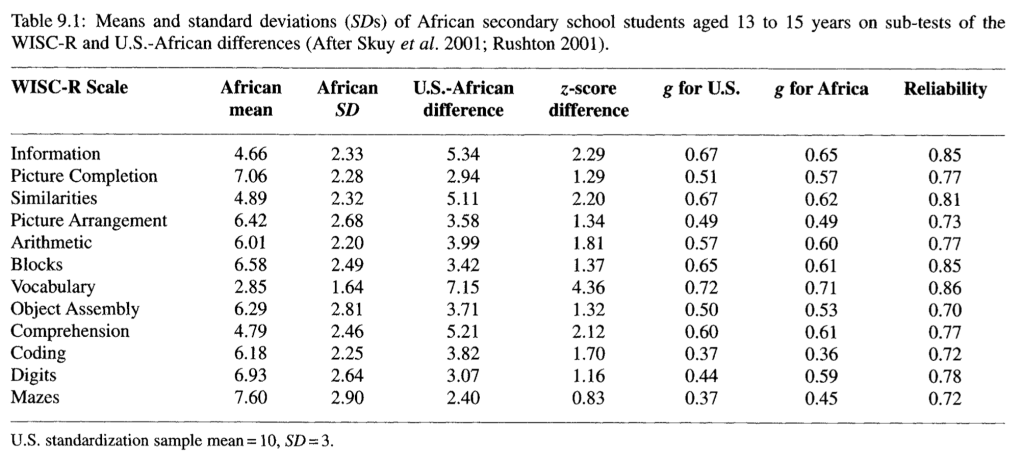
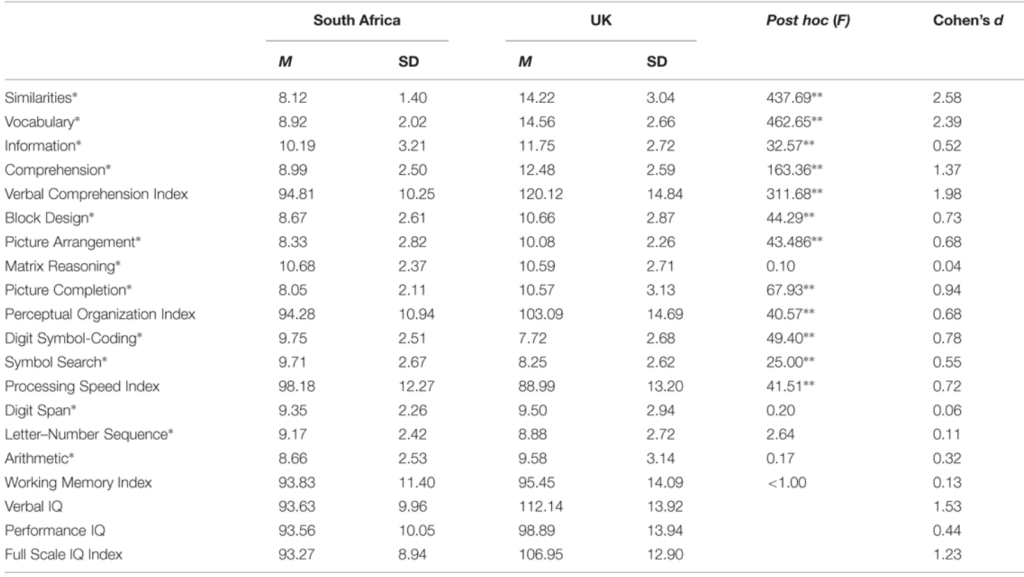
Strikingly all tests in this study show lower SDs for the African students
In this study most subtests show lower SD for the South Africans with a four point differences in SD in the Performance and Full Scale IQ

One possible influence on the standard deviation would be admixture. If a population is a relatively recent mix of two populations with a different mean, the new population would have a higher SD. Basically the variation in admixture percentage would add to the trait SD. This can be observed in Hispanics, see my blogpost [2]. Of course African Americans are an admixed population with roughly 20% white admixture, while white Americans aren’t, so purely African African Americans should have an even lower standard dev than the current population.

In non-admixed populations the standard deviation of a trait ultimately directly depends on assortative mating for that trait. It is intuitive that random mating minimizes differences because people high on a trait and people low on a trait mix genes often. Strong assortative mating sees a widening of the bell curve up to a steady state influenced by the heritability of the trait.

So one interpretation of this observation would be that environments that select for a trait are environments in which this trait is valued, which means that assortative mating is strong. In that case we would expect to see populations with a high mean to also have a high standard dev and vice versa, which is kind of what we see in IQ. But as the blogpost linked above shows, the standard deviation of violent crime is higher in Whites although the mean is lower. This seems to constitute a counter example, until we realize that the trait under selection here might be peaceful behavior.

But there are also possible explanations that don’t invoke selection pressure. For example a population that has local mating, but a global cline in the trait in question, will have globally a higher standard deviation. Such a cline is often observed in IQ where the Northern parts of many countries are higher in IQ than the Southern parts, though occasionally it is the other way round. Nigeria is probably an extreme example for such an IQ cline, see [3]. So Nigerians as a whole population might have quite a high standard deviation. However, the resulting distribution in Nigeria would not be gaussian, but multimodal, because the different ethnic groups are very much endogamous. So Whites might have higher standard deviations simply because they have historically formed larger endogamous groups or rather endogamous groups that stretch over more terrain. This explanation would predict tails that are slimmer than expected, because the distribution is not fully gaussian. This scenario is somewhat comparable to the admixture case mentioned above.

A third and maybe most convincing scenario combines aspects of the other two ideas: Maybe standard deviations depend on the historical sophistication of societies. More advanced societies lead to stronger social stratification and this in turn leads to stronger assortative mating even without changing the preferences of the people involved. Assortative mating would partly be a byproduct of assortative socializing in socially stratified societies.

[1] Why most serial killers are white men.
http://www.lagriffedulion.f2s.com/serial.htm

[2] Hereditarianism III: Discussion
https://halfassed.science.blog/2019/04/27/hereditarianism-iii-discussion/

[3] An answer to Chanda Chisala
https://halfassed.science.blog/2019/12/21/an-answer-to-chanda-chisala/
Demographic Change in France – Prenoms Rare

In my blogposts on demographic change in France I have discussed the growing percentage of kids of African origin in France. If estimated via the number of kids that are tested on sickle cell anemia, this percentage has surpassed 40% and has more than doubled since the year 2000. I counted the change in how many newborns are given typical Muslim names and could validate at least the growth rate of the sickle cell data, roughly a doubling between 2000 and 2015. It’s now 1.5 years since I analyzed the data and I decided to revisit the newest given name database, which is updated every year by the French bureau of statistics INSEE.

Re-checking the percentage of muslim names, I made the surprising discovery that since 2016 this percentage has stopped growing. For comparison, the number of names covered by my short list of muslim names is 13003, 26926, 25873 for the year 2000, 2015 and 2018. Given that the number of births has been dropping slightly, this translates into the percentage staying steady over 2015, 2016, 2017 and 2018.

If the muslim population from the Maghreb were the only sickle cell tested kids, this would translate to a steady 40% of kids with African origin. However, this is not the case. Subsaharan immigrants to France usually aren’t Muslims, so even if the percentage of Muslim kids has stopped growing, the original „sickle cell“ percentage might still be growing. (The sickle cell statistic has long been discontinued, for obvious reasons.)

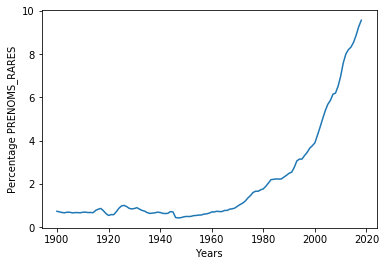
Looking through the data I came across the prenoms rare, the rare first names. Under this moniker the kids are counted that have been given a relatively rare name. Contrary to the Muslim names, the percentage of prenoms rare has been steadily rising even in the last few years. I looked back a bit and made the discovery that this percentage has been doubling every twenty years or so since world war 2.

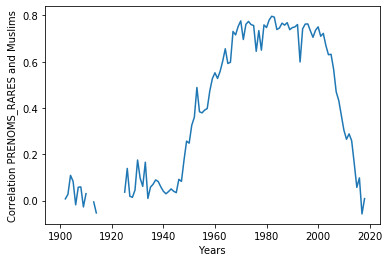
Given that the Muslim names had stopped increasing recently and given that this exponential growth seems to have started very early, surely before mass immigration, I was ready to interpret it as a trend of the French society towards greater and greater individualism or something. Then I decided to check whether the percentage of Muslim names in the different departments correlates with the percentage of prenoms rare:

It turns out that there is a significant correlation starting in the year 1949, that steadily increases as more and more departments have a count of Muslim names above zero until it reaches almost 0.80. In the early 2000s it suddenly starts dropping and has vanished by 2014. So what’s going on?

One thing that might contribute to killing off the correlation is that names of a 20% minority just aren’t as rare as names of a <10% minority. So Muslims might have slowly outgrown the prenoms rare marker. But the prenoms rare keep rising exponentially, so if Muslim names are getting less rare there has to be another driver of that growth. If we look at the intercept of the linear fit between the Muslim names and the prenoms rare percentage, that is the extrapolated prenoms rare for a department with zero Muslims, we get the following pattern over time:

There is something like 1% of rare names in the original French population and this probably doesn’t change too much. But starting in the 1970s there is an increase in the rare names independent of Muslims names that shows roughly a doubling every ten years or so. It seems probable that this is driven by non-Muslim immigration. However, when I look for the names that correlate strongest with prenoms rare over the different departments I get anything but rare names:

(0.47688124948411037, 1.8063429505759013e-76, ‘GABRIEL’),
(0.470505323840092, 3.2246147618498544e-74, ‘LIAM’),
(0.4416925115802408, 1.2859076223422156e-64, ‘MAËL’),
(0.4326625169376073, 8.57024632603287e-62, ‘MIA’),
(0.4206020094129121, 3.743600297108489e-58, ‘TIMÉO’),
(0.4190831094973139, 1.0503598293466153e-57, ‘ADAM’),
(0.4149723540036518, 1.6689711293740196e-56, ‘NOÉ’),
(0.4079050152026234, 1.7728242577990175e-54, ‘TIAGO’),
(0.4039208782138888, 2.342116862082597e-53, ‘KAÏS’),
(0.3975213210364356, 1.3754944258800354e-51, ‘EDEN’),
(0.39080880395597334, 8.963524732093063e-50, ‘ISSA’),
(0.39039340121367977, 1.1570834678410338e-49, ‘MILA’),
(0.3895565952224957, 1.9331033907637143e-49, ‘ISMAËL’) …

This seems to mostly pick up on urbanisation, which is in line with prenoms rare being driven by immigration. However, the hope to find actual names that represent the prenoms rare population comes to nothing. So again we are left without a sensible measure of the non-Muslim African population growth in France. But with the massive increase in prenoms rare it seems unlikely the entire „sickle cell“ percentage has petered off like the Muslim names.

Why I do not believe in a big dysgenic effect in the West

There are now several convincing papers that show a dysgenic effect in Western countries, but when I say big dysgenic effect what I mean are the estimates given by Woodley of Menie. He claims that in great Britain over the last hundred years average IQ has dropped by more than 10 points, that is 1 point per decade.

There are several reasons why I find these estimates unrealistic. One reason is that for such a big dysgenic effect presumably limited to western countries, the IQ gaps we see today are remarkably similar to Galton’s estimates 160 years ago.

Another reason to be skeptical is that we actually live in the golden age of mathematics. It seems unrealistic that after a drop of more than 10 points we would still have the geniuses to solve century old problems like the Poincare conjecture or Fermat’s last theorem.

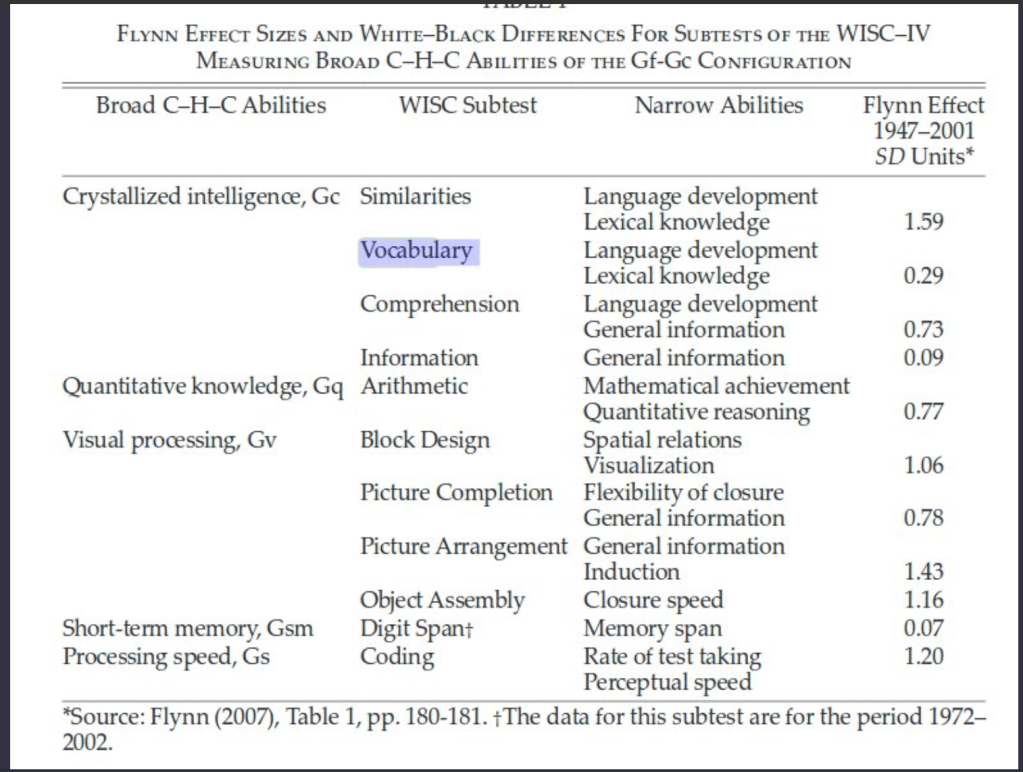
I would also assume that some of the normal IQ tests used in the Wechsler test, would show a negative Flynn effect over the last decades. In actual fact the Flynn effect of the different subtests ranges from 0.07 to 1.59 standard deviations for the second five decades of the last century in the US. If the effect of environmental improvements can range from 0 to „a lot“, it seems a priori unlikely that the subtests with the weakest Flynn effect more or less exactly cancels a large dysgenic effect.

Flynn effect in the US between 1947 and 2001, don’t ask me why vocabulary is marked.

Woodley’s shtick is to find different traits that correlate with IQ and show that some sample many decades ago scored better than the average person does today. Unfortunately, this amounts to cherry picking and the long time between the studies makes sampling problems impossible to rule out.

Myopia for example correlates with IQ and has become much more prevalent in the last century. The correlation is even due to an overlap of genetic factors. Does the increasing prevalence of myopia prove a eugenic effect? Hardly. The true dysgenic effect is probably 2 to 5 times weaker as estimated via polygenic scores for the population of Iceland.