
The relationship between ethnic composition and GDP/IQ that we investigated in the previous blogpost, allows us to compute an upper limit of the reverse causality, that is of the causal effect of GDP on IQ. To do that we predict IQ from ethnic composition, and use that function to correct our IQ values for ethnicity. That way we remove the influence of ethnicity from the IQ data. Only the remaining IQ differences can be caused by GDP or other environmental factors.
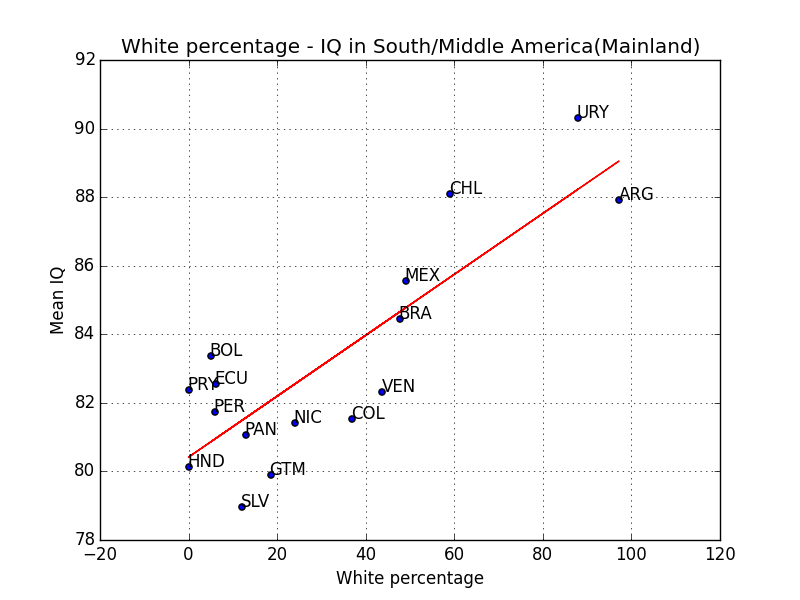
We start again with the mainland countries of South and Middle America. The correlation between IQ and percentage of the population that identifies as white is quite strong with 0.838 (p<5.1e-5). The red line is the best fit according to least squared error. Now, by looking at the deviation of the actual IQ values from the values predicted by the white percentage, we can try to find effects on IQ apart from ethnicity.
In this case, however, we come up empty. The residual IQ values do not correlate significantly with GDP (0.25, p<0.35). This does not mean that there is no reverse causality from GDP to IQ, only that if there is any, it is hidden in a feedback loop. I.e. smart people have a strong economy, which makes them even smarter. The takeaway is still that for these countries ethnic composition explains both IQ, and via IQ, also GDP, with each IQ point being worth 1419 dollar in GDP.

The situation is quite different for the South and Middle American islands. Here, black percentage explains a large part of the IQ differences (correlation of -0.58, p<0.03). However, black percentage does not correlate with GDP. This is due to a large fraction of countries that got relatively wealthy by non-industrial means, ie. as tax havens or tourist destinations. Nonetheless, there is a correlation of 0.658 (p<0.011) between IQ and GDP!
So, ethnicity correlates with IQ. IQ correlates with GDP. But ethnicity does not correlate with GDP! This implies that the GDP-IQ correlation in this case is not caused by ethnicity. And indeed, if we control for black percentage, the IQ residual still correlates 0.644 (p<0.013) with GDP.

Here, we finally have some nice evidence for reverse causality. We can see a leveling off after 20,000 dollar. The Bahamas and Trinidad &Tobago are still on the level of Barbados, and Puerto Rico and Saint Kitts & Nevis are still on the level of Dominica etc., despite being much richer. Between 10,000 and 20,000 dollar GDP per capita there seems to be a strong effect on IQ, with every 500 dollar or so buying an IQ point.
Note, that the overall relationship of a single IQ point with GDP, as observed in the mainland countries, is almost three times as large. This should give rise to a feedback effect, where every IQ point gained, nets enough GDP to further increase IQ by two points. Consequently, countries in this zone should converge towards their ceiling. A runaway IQ effect. Which, of course, still takes generations.
 Half-Assed Science