In sports we often have incredibly dominant athletes, that for a while make it very clear who is on top. In chess that is particularly noticeable with Carlsen topping the rating list for almost ten years now, Kasparov before him being head and shoulders above everyone else and many other champions enjoying long undisputed reigns (Karpov, Casablanca) or at least short extremely dominant stretches (Alekhine, Fischer).
But the same holds for many other sports as well. Federer, Klitschko, Tiger Woods, Carl Lewis, etc. etc. I recently realized that this is at least partly a direct consequence of abilities being normally distributed. In a normal distribution the number of athletes within an ability bucket of a certain size drops exponentially the farther out from the mean you look. Intuitively this means that the top athlete might get his very own bucket, while the preceding bucket is already filled with, let’s say, ten rivals. Consequently the average distance to the next best athlete must be exponentially smaller the closer you get to the mean.
This exponentially bigger distance to the next best rival is what we call dominance. Counterintuitively this entails that the stronger the competition in a given sport the more dominant the top athlete is likely to be. Simply because the top in a very competitive field is going to be farther out from the mean. Of course this mathematical relationship doesn’t hold as strongly in teams sports. In teams sports dominance is more likely to result from winner-takes-all dynamics.
I Modern dating apps and sites have given us data to quantify differences in mate choice between men and women. Specifically, female hypergamy, that is the preference of women to date the highest status men, can now be observed in hard data. It turns out that average man is really not attractive to the average women. Instead 80% of the women chase after 20% of the men. This is in itself worrisome if one regards falling birth rates and disenfranchised men as a problem.
II It is also the reason why I think polyamory would be a very bad social norm. Polyamory is the habit or norm of having multiple partners at the same time. Its proponents argue that it would solve the disenfranchised men’s problem, because they could still become secondary or tertiary partners. Why women would want a secondary or tertiary partner that is not attractive to them is anybodies guess. Instead polyamory solves the female conundrum: Suddenly the attractive 20% of the men can be available to 80% of the women.
III In the end polyamory makes the mating market more efficient. Just like dating apps or dating sites. Unfortunately, making the mating market more efficient just means that the messed up female preferences make life miserable for both men and women.
I Bloggers like HBDchick and increasingly mainstream scientist and authors argue that the unusual history of (partly Church mandated) outbreeding, certain societal structures / customs and the steady replacement of the lower classes by the middle class has changed Europeans genetically to exhibit higher intelligence, more moral behavior induced by a stronger propensity for guilt, less nepotism, less violence and more empathy, altruism and trust for strangers than basically any non-European ethnicity. This is the putative origin of the WEIRD psychology.
II I don’t know to which degree this is correct, but it is definitely not a non-starter. One can leverage a lot of data to show the trait differences of WEIRDoes compared to the rest of the world. There is some data to imply a genetic cause of the observed differences and the evolutionary stories at least sound somewhat plausible.
III Now HBDchick is likely a lovely person with no bad intent, but her work can of course be used to argue for some form of white supremacy. This, however, quickly leads to a funny contradiction, which seems to me to be the central contradiction of white supremacy: Along every dimension white supremacists are more like the rest of the world and less like the WEIRD.
IV They are less intelligent, to a degree that the right generally has a recognizable human capital problem. They abhor the „pathological“ altruism exhibited by their co-ethnics. They are certainly more violent and would have a hard time to argue for moral superiority. One could go so far as to say that Western leftism is exactly the quintessence of what makes Europeans different from the rest of the world!
In a Q&A a few years back, Jordan Peterson opined that there are 6 or 7 bad trends, which if unchecked could lead to very bad things. I’m paraphrasing, I don’t remember the exact words. But I would have loved to get the opportunity to ask him which trends he was talking about. The picture of seven bad trends stayed with me and occasionally I try to come up with my own list.
Following the scientific and technological progress in fields like AI, genomics and spacefaring closely, can leave the strong impression that mankind is quite close to making very big strides. Strides that would take us to a position from which our current problems are (easily) solvable.
I call that „reaching escape velocity“. The point where our technological and scientific acumen accumulates faster than our problems compound.
Of course when you are sitting in a rattling box of metal that accelerates into the impenetrable mist ahead, it is very unclear whether you are ever going to reach escape velocity. Maybe you’ll crash and burn instead. Or just sort of putter out.
Climate change can serve as a stand-in for all kinds of environmental degradation and resource exhaustion. Mass migration and birth rate collapse together lead to a population turn-over in the countries that historically have been the engine of scientific and technological growth.
This alone might stall the global growth machine, but on top of it there is dysgenic decline going on in almost all countries at the rate of probably 1 IQ point per generation possibly more. That the ongoing population replacement also engenders ethnic conflict only makes it more likely that the Western world will not be able to continue to drive innovation.
It is unclear how much automation already plays a role. We can also use it as a stand-in for all economic forces that squeeze the little man. So far mostly globalisation. Next to the population replacement this is the other big driver of political polarization. Which ultimately feeds into ethnic conflict. On the one hand because almost all violent group conflict is between ethnic groups and on the other hand because very concretely left wokeness is largely based on ethnic hate and the right-wing reaction to it is no stranger to racism either to put it mildly.
I The investigation into a lot of societal questions comes down to base rates. If a black guy is called a fucking n***r, in many cases this undoubtedly comes down to racism. If he and other black persons are often insulted in such fashion one can probably make a reasonable case for a racist society.
On the other hand I was called a fucking bastard just last week for no reason. Would that person have availed himself to a racist insult if I’d been a darker shade of pale? Quite possibly. Insults are meant to hurt and racism fits that bill.
So a better measure for the prevalence of racism in a society would probably be whether minorities are more often insulted than people of the majority all else equal and not so much how those insults are couched. People who hate everybody equally are not racist.
II
I wonder whether displays of homophobia, especially among adolescents, aren’t often better explained by status games than, well, actual homophobia. If gays are lower status, implying somebody is gay, or denying to be gay is not motivated by homophobia. It is merely a try to lower somebodies status or to defend against such an attack.
Of course, one could say that gays being lower status is due to homophobia. But that is not a foregone conclusion. There are systematic trait differences between gays and heteros, so gays might be lower status because they are more feminine. Or they are lower status because they miss out on one key aspect of intra-male competition. In that case a teenager calling somebody gay, is just saying „you don’t compete for females!“. And the forceful denial is just „but I do, I do“ bangs chest.
III The point of these speculations is not to explain away suffering caused by hurtful remarks or actual discrimination. But in a way I do discount lived experience. Namely, when it is invoked in lieu of actual solid evidence for societal problems.
Because counting names is one of my modus operandi, today we are going to take a quick look at the names that are really specific to each ethnic group in the US according to the US census. To that end we order the names by percentage of the population that belongs to the given ethnic group and bears that name. We restrict ourselves to names borne by at least 1000 people.
Germans, Dutch, Eastern Europeans of different couleur including Ashkenazim. Latecomers that didn’t have the opportunity to gift their names to the African American population.
Same pattern applies. These seem to be genuinely African names. Maybe some latecomers also. If we increase the cutoff to 10.000 people bearing the name, we get 90.49 SMALLS, 87.53 WASHINGTON, 86.74 PIERRE, 82.86 MUHAMMAD, 80.85 HAIRSTON, 80.4 RUFFIN. All the African names are gone and the names become very unspecific.
The hispanic names are dominated by the Spanish style double name. Makes sense that these are recent immigrants still following that naming convention. If we increase the cutoff to at least 10.000 people bearing the name, these double names completely vanish.
And finally we have a really short list of native American names. There just aren’t all that many Natives around and most of those are mixed in some way or form, which means that their names have likely bled into the white population.
These investigation shows the difficulty of assessing ethnicity by name: Only recent immigrants still bear really distinguishing names.
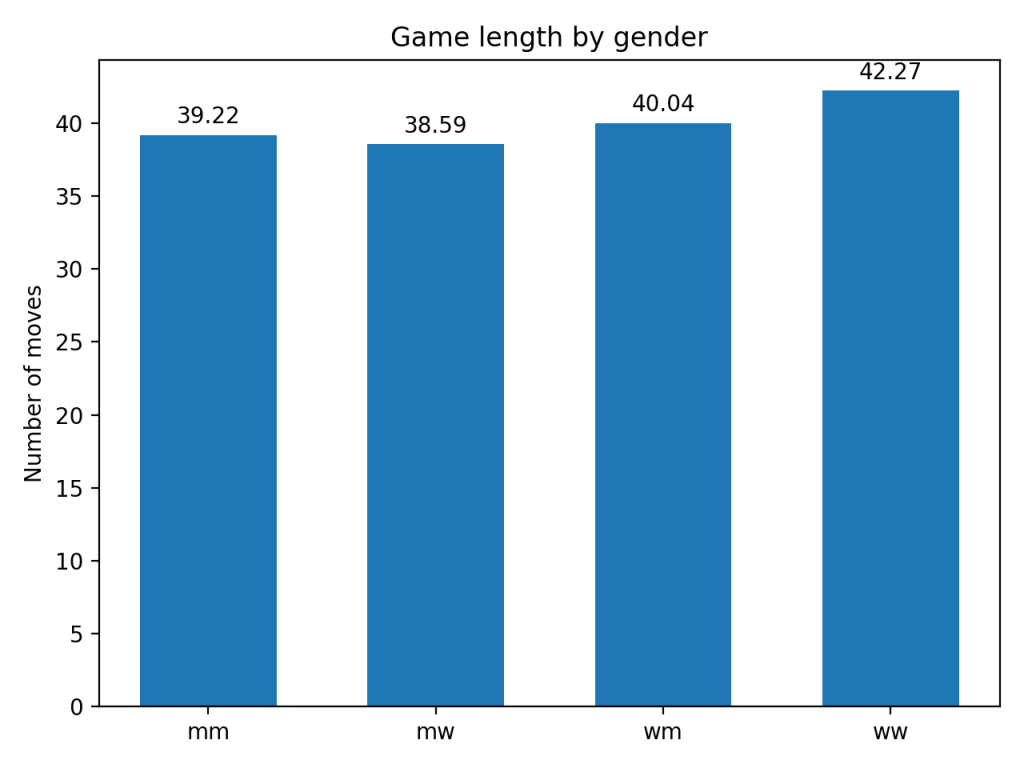
One of the easiest metrics to extract from chess databases is the number of moves certain games contain on average. This can be seen as a measure of grit – both the determination to beat the other player even if it takes 7h and 120 moves to do so, and also the ability to hang in there and defend bad positions for a long time to save the draw.
Unfortunately at the same time it can also be a measure of caution: Very aggressively played games tend to be short, such is the nature of risk taking.
Nevertheless, we take the opportunity to shine further light onto the male-female over-the-board-relationship. For this little investigation we look at the length of games between women and men, men and men, and finally women and women. We use a different method here to identify female players. Instead to trying to connect the players to the Fide player database, we just classify the players given name into male or female. This provides us with a few hundred games for each combination of male and female where both players are rated above 1500 Elo.
We see that men playing white against women probably try a little shorter to turn the first move into a win than against men, while women generally play somewhat longer games. But overall the differences aren’t too big. Not terribly exciting but another indication, that men probably on average do not try harder to beat women than to beat other men.
I Women and men are organized into different social hierarchies that don’t usually overlap all that much. Female hierarchies have stronger components of conformism and imitating the behavior of the top, ah, bitch. Male hierarchies are more based on dominance and skill.
One thing that happened with the emancipation of women and the integration of women into the workforce, was that women are now to a much larger degree part of male hierarchies. I believe the complaint that women aren’t taken as seriously even with superior skill is based on women being on average lower status than similarly skilled men. That is simply the result of women not being as good as men at playing the male hierarchy game.
And why would they be? Height and strength are only the most obvious deficiencies that women have on that playing field. And of course the incentives are very different. Men at the top of the hierarchy have access to the best mates. Women at the top of male hierarchies stay childless.
Unfortunately I also suspect that male hierarchies are a lot better at getting things done. For example men are able to work with people they dislike, possibly because failure to cooperate for men had immediate very bad consequences in the evolutionarily typical male endeavors. So it seems unlikely that this problem has an easy solution.
II Additionally it seems to be the case that female hierarchies have become more dysfunctional in our day and age than male hierarchies. Imitating the top bitch is all well and good if you are living in a village or a band of hunter-gatherers. If the top bitch is a celebrity of unattainable perfection, not so much.
If your conformism is hijacked by the fashion industry on the one hand and crazy political ideologues on the other, the result is also not very pretty. It always strikes me as ironic that many of the problems of modern women/girls that are blamed on the patriarchy are the direct result of intra female competition with hardly a (hetero) male involved.
Years ago when Jamaican sprinters started to dominate the 100m/200m dashes, it was whispered that they had unusual jaw growth, some of them needing braces even in their early twenties. The allegation was that they used HGH, human growth hormone, that besides improving performance had side effects on the growth of extremities.
These side effect can occur naturally, usually if there is a tumor in the pituitary gland and very high amounts of growth hormone are created. This leads to a condition called Acromegaly, where jaw and brow ridge and basically everything else grows to almost grotesk proportions. André the giant may be most famous example, or Richard Kiel playing Jaws in the Bond movies.
At one of the recent Olympics, maybe 2012 or maybe 2016, I was struck by how similar the two superstars Micheal Phelps and Usain Bolt looked in terms of their body shape. Long, lean with a strong jaw and big hands and feet (Usain Bolt has shoe size 13, Phelps size 14).
I began wondering whether HGH-abuse, probably starting already in teenage years, was playing a major role in shifting the borders of human performance in high level sports. In swimming the never-ending flood of world records was explained by the improvements of full body swimming suits. Of course when these suits were banned records kept falling.
HGH leads to detectable changes in the facial structure. And Deep Learning methods allow us to turn pictures of faces into vectors that encode facial structures. This gives us a way to empirically assess whether faces of world class athletes have been shifted towards the facial structure typical for people suffering Acromegaly.
These people suffer from Acromegaly
Because this is half-assed science and not full-assed science and there is, as always, a severe lack of graduate slaves, we will only manage a proof of concept. For this we select the male Olympic finalists in swimming for the years 1976, 1992 and 2016. These three years fall into three different phases of HGH-abuse: HGH has been used in high-level sport since 1982 and it was possible to detect it’s abuse since the early 2000s. So 1976 is pre-HGH, 1992 is HGH-time with no risk of being caught and 2016 is HGH-time with the theoretical possibility of being caught.
We also select the a couple of people suffering Acromegaly, as given by the wiki-article on the subject. And as a control group a number of normal guys, by googling ‚random guy‘ and ‚normal guy‘. We use a model that creates face embeddings, that is it detects faces in a picture and assigns vectors to these faces that encode facial structure.
We then compare the average face vector for our Olympic finalists and normal guys with the average Acromegaly face vector. Our results show that the distance to the facial structure typical for Acromegaly was biggest in 1976 with 0.671, smallest in 1992 with 0.625 and a little bigger than 1992 in 2016 with 0.634. The normal guys have on average a face 0.658 away from the Acromegaly face. The standard deviation of the distance of normal guys is 0.058, so the difference between 1976 and 1992 is 0.78 standard deviations.
This is certainly a big difference and the pattern of differences between 1976, 1992 and 2016 fit the different phases of HGH-abuse very well. The only thing that should give us pause is the fact that my normal guys are closer to the Acromegaly face than the 1976 athletes. More work is needed, but probably not by me!
I It confuses me that vegans state animal welfare as a reason for foregoing meat, despite the fact that the animals vegans claim to care for largely wouldn’t even exist if they weren’t eaten by humans. Even granting that non-existence is better than some versions of factory farming, clearly the most moral course of action, if one gives moral valence to animals, is to buy as much meat from happy chickens as possible. This way one supports the happy existence of thousands of animals throughout one’s life. And if you buy meat, you might as well eat it.
II Throughout history philosophers have tried to create consistent theories of moral behavior. Much like vegans they don’t usually even get close. I believe the reason for this is that the human mind has moral intuitions that are shallow situation filters. Each evolved to trigger a behavior in a certain social situation that is advantageous in the long term. But if situations don’t usually trigger several moral intuitions there is no reason to believe that these intuitions are consistent with each other. Trying to build a consistent framework on top of these inconsistent intuitions will always fail because thought experiments like the famous trolley problem easily expose the fault lines where our intuitions cannot be stitched together.
III I believe Singers arguments also amount to the extrapolation of shallow filters. Singer argues that geographical distance should have no effect on moral judgements, so that the child you could save on a different continent is equivalent to the child you might pull out of a river right here. This seems very reasonable because imagining a child dying in Africa and imagining a child dying right here certainly feels very similar. It both feels like imagining. Of course in reality there is a gigantic difference in our moral intuition concerning a child we see drowning in front of our eyes and a statistic. Our intuition is that we have much stronger moral obligations towards people who are present, who we know or who are related to us. (Reading Singer’s wikipedia page right now, it seems he also managed to be wrong about everything else. Of course that’s probably the only way to make a career in philosophy.)



 Half-Assed Science